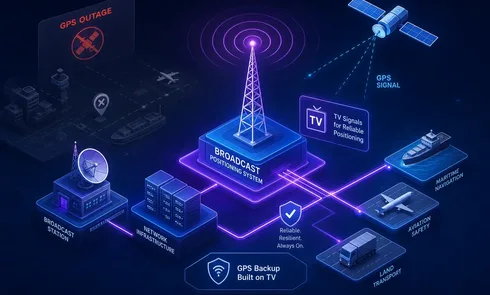
The Broadcast Positioning System (BPS) has delivered precise, GPS-independent time to a live 500 kV Dominion Energy transmission substation, and Avateq Corp. is proud that its engineering team's hardware played a central role across the entire over-the-air timing chain.
Over a 45-day field trial led by Merkhet Solutions in Fairfax, Virginia, UTC(NIST)-traceable time embedded in ATSC 3.0 ("NextGen TV") broadcast signals was fed directly into Dominion Energy's digital fault-recording system without interrupting substation operations. Powered end to end by Avateq's AVQ1050 ATSC 3.0 BPS Receiver and Synchronizer, operating in Synchronizer mode (AVQ1050S) at both broadcast transmitter sites and Receiver mode (AVQ1050R) for both the inter-station relay and substation reception, the system delivered timing accuracy well beyond Dominion Energy's operational requirements.
Why Substations Need a Terrestrial Alternative to GPS
Modern electric grids depend on tightly synchronized clocks. Utilities align measurements across interconnected substations to analyze grid events, locate transmission-line faults quickly, support regulatory compliance, and operate synchrophasors and IEC 61850 digital substations.
Historically, GPS has been the primary, and often sole, source of that timing. Because satellite signals arrive at the Earth's surface extremely weak (roughly -158 dBW), they remain vulnerable to jamming, spoofing, and solar-storm interference. Local holdover atomic clocks can bridge short outages, but they are costly and provide only temporary protection. Utilities have been looking for a persistent, high-power terrestrial timing source that operates independently of satellites and integrates cleanly with existing substation equipment.
BPS answers that need by embedding UTC-traceable time directly into existing high-power ATSC 3.0 television broadcasts on licensed spectrum. Broadcast towers are engineered to stay on the air 24/7/365, including during emergencies, creating a resilient co-primary timing path alongside GPS.
End-to-End Signal Chain: Powered by AVQ1050S and AVQ1050R
A practical BPS network depends on tight hardware coordination at every hop: accurately embedding time into the broadcast waveform, relaying that time between towers without relying on GNSS, and recovering it cleanly at the end-user site. Avateq's engineering team designed the ActiveCore-based AVQ1050 platform specifically to handle both sides of that chain:
- Leader Transmitter, WHUT (Washington, D.C., ~30 km from the substation): WHUT operated as the BPS leader station with UTC(NIST)-traceable time and a local cesium holdover clock. An AVQ1050S continuously monitored the time stamp in WHUT's ATSC 3.0 frame preamble and fed real-time corrections to the BPS-enabled exciter.
- Follower Transmitter, WNUV (Baltimore, MD, ~56 km from WHUT / ~88 km from the substation): To demonstrate GPS-independent multi-hop time distribution, WNUV operated as a follower station. An AVQ1050R at WNUV received WHUT's over-the-air BPS broadcast and delivered a precise time reference directly into a second AVQ1050S, which synchronized WNUV's own ATSC 3.0 transmission (backed by local holdover).
- Dominion Energy Substation (Fairfax, VA): Merkhet Solutions mounted directional TV receive antennas on the substation's communications tower and routed cabling into the operations building, feeding two rack-mounted AVQ1050R receivers: one tuned to WHUT (~30 km, a typical coverage path) and one tuned to WNUV (~88 km, outside the station's normal TV service contour across suburban, urban, dense-urban, and wooded terrain to stress-test reception). Each AVQ1050R recovered UTC-traceable time solely from the off-air ATSC 3.0 signal and output an IRIG-B timing signal directly into Dominion Energy's Digital Fault Recorder (DFR).
Trial Results: Far Inside the 1 Microsecond Target
Dominion Energy's timing requirement for synchrophasor operation is 1 microsecond (1,000 nanoseconds). Across the 45-day trial, BPS performance from both transmitters consistently exceeded that benchmark, with Merkhet Solutions and Dominion Energy each conducting independent monitoring and analysis:
- WHUT (~30 km leader path): In Merkhet Solutions' published 8-day Time Interval Error (TIE) dataset (10-minute averages), the AVQ1050R tuned to WHUT stayed within +/-25 ns of GPS.
- WNUV (~88 km stressed follower path): Despite the two-hop over-the-air relay, long distance, and weaker reception conditions outside WNUV's coverage contour, the AVQ1050R tuned to WNUV stayed within +/-50 ns of GPS.
- Independent Grid Verification: Dominion Energy's own DFR data showed BPS-synchronized three-phase synchrophasor voltage readings on a 500 kV transmission line matching GPS-timed measurements captured at the opposite end of the same line.
As Collin Gray, Engineer - Fault Analysis at Dominion Energy, noted in Merkhet Solutions' case study and in coverage by TV Tech, dependable time synchronization is becoming increasingly critical as utilities adopt synchrophasors and IEC 61850 digital substations, and the pilot proved BPS to be an accurate terrestrial alternative to GPS timing.
Engineered for Real-World BPS Deployment
Seeing the AVQ1050 perform continuously across 45 days in a live 500 kV substation while simultaneously locking a leader station, bridging a 56 km over-the-air leader-to-follower link, and maintaining +/-50 ns accuracy over a deliberately stressed 88 km path is a milestone for Avateq's engineering team.
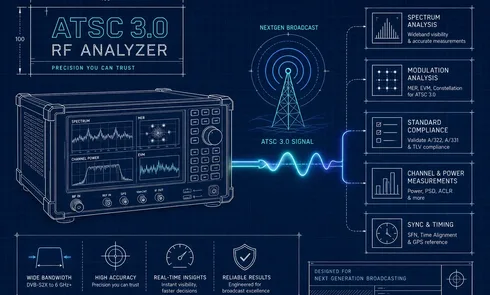
Developed and built by Avateq's engineers, the AVQ1050 combines precision RF demodulation, multipath-aware Time-of-Arrival processing, and flexible timing interfaces in a single 1U platform. In Synchronizer mode (AVQ1050S), it keeps ATSC 3.0 exciters tightly locked to the BPS time reference. In Receiver mode (AVQ1050R), it recovers traceable time from off-air ATSC 3.0 signals and provides 1PPS, 10 MHz, and IRIG-B (IRIG-B126) outputs ready to interface with broadcast transmitters, monitoring chains, and substation fault-recording systems.
Scaling Resilient Time Across Critical Infrastructure
The Dominion Energy trial builds directly on earlier validation by the National Institute of Standards and Technology (NIST), whose 2025 evaluation concluded that BPS time transfer performs on par with or better than GNSS. According to Merkhet Solutions, the two broadcast towers used in this trial alone cover more than 81,000 square miles of predicted BPS service area. This demonstrates how a small number of high-power ATSC 3.0 transmitters with leader-site cesium holdover can deliver resilient, UTC(NIST)-traceable timing to thousands of energy, telecom, data center, and financial sites.
Avateq congratulates the Merkhet Solutions team on an outstanding field deployment and thanks Dominion Energy for hosting the trial and validating BPS in a live 500 kV operating environment.
To learn more about the Avateq's AVQ1050 ATSC 3.0 BPS Receiver and Synchronizer or to discuss BPS timing for your broadcast or critical-infrastructure deployment, contact the Avateq engineering team or request a demo.