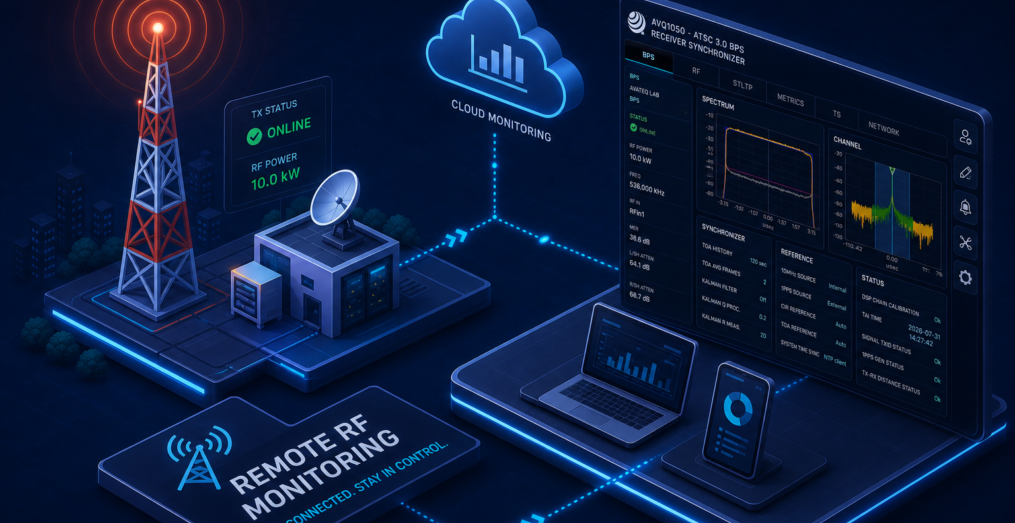
It's 2 a.m. Your transmitter site has been degrading for the past ninety minutes. You find out not from an automated alert but from a viewer who called the station. Choosing the best remote RF monitoring solution for broadcast transmitters is exactly what prevents that scenario, and it plays out every week at broadcast facilities across the country. Every time it does, it costs real money: a truck roll, a few hours of degraded signal, and a gap in your FCC documentation that you'll explain later. The fix isn't complicated. It's a well-chosen remote RF monitoring system deployed before the next failure event, not after.
At Avateq Corp., remote transmitter monitoring is one of the first conversations we have with engineers planning an ATSC 3.0 deployment or tightening up an existing multi-site network. The questions are consistent: which metrics actually matter, which protocols connect to my NMS, how does this work over existing communication networks (e.g.,LTE backhaul or Microwave links), and what does it cost? This guide answers all of those questions in sequence. No vendor cheerleading, just the framework you need to make a defensible procurement decision.
Why Unmonitored Transmitter Sites Are an Expensive Gamble
The Real Cost of a Single Undetected Transmitter Fault
The fully loaded cost of an unplanned transmitter truck roll, including labor, travel, and downtime, lands somewhere between $500 and $2,000 per incident depending on site distance, repair complexity, and how long the signal was degraded before anyone noticed. That range doesn't capture the reputational hit or any retransmission exposure for stations with contractual SLA obligations. A single prevented incident often pays for a year of continuous monitoring hardware.
The subtler problem is the gap between "transmitter is on-air" and "transmitter is performing to spec." A transmitter can be radiating power, showing a green light on the exciter, and still delivering a signal that 15 percent of your viewers' receivers can't decode cleanly. Forward power alone doesn't tell you that. MER and BER do. Without continuous signal quality monitoring, you're flying on the assumption that power output equals viewer experience, and that assumption fails more often than most engineers expect.
FCC Compliance Pressure and the Documentation Gap
Under 47 CFR §73.1590, TV stations are required to maintain equipment performance measurement records, signed and dated, for two years and produce them for FCC inspection on request. Manual spot-checks generate point-in-time snapshots, not the continuous, timestamped telemetry history that an audit or license renewal may require. If an interference complaint surfaces three weeks after an event, a spot-check from that morning doesn't help you.
Continuous monitoring with internal logging closes that documentation gap automatically. Every alarm event, every performance drift, every threshold exceedance is timestamped and retrievable. That's not just good operational hygiene, it's the difference between having evidence and not having it when the FCC comes asking.
The Telemetry Metrics a Capable Monitoring System Must Report
RF Path Health: Forward Power, Reflected Power, and VSWR
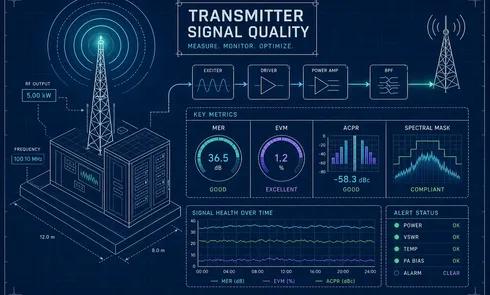
These three measurements are non-negotiable for any in-line transmitter monitoring deployment. Forward power confirms the transmitter is producing output. Reflected power and VSWR tell you whether that output is reaching the antenna or bouncing back through feedline and antenna system faults. A rising VSWR trend is a more useful early warning than a static threshold alarm because it shows you the direction of travel before a component actually fails.
Signal Quality Indicators: MER, BER, Constellation Integrity andIn-band Interference
For ATSC 3.0 operations, forward power tells you almost nothing about receiver experience. Modulation Error Ratio (MER) and Bit Error Rate (BER) are the real quality gates. MER measures how cleanly your signal conforms to the modulation template; BER measures how many bits are arriving corrupted at the receiver. Both can degrade while your transmitter stays on-air and your power meter reads normal.
Constellation visualization adds a layer that numeric metrics alone miss. A rotated or compressed constellation tells you there's a phase or amplitude distortion problem in your signal chain. A scattered constellation points to noise floor issues or nonlinearity. Diagnosing those faults from a single MER number is guesswork, seeing the constellation makes the root cause far more obvious.
In-band interference characterizes unwanted signal products generated by transmission chain non-linearity.
Environmental and System Health Data
Temperature, cooling system status, and PA supply voltage complete the telemetry picture. A transmitter running 15 degrees Celsius above its thermal design point is a failure event waiting to happen, even if its RF output looks clean right now. A good monitoring system surfaces environmental data on the same dashboard as RF metrics so your NOC team sees the full picture without switching between tools.
How to Choose the Best Remote RF Monitoring Solution for Broadcast Transmitters: Protocols and Integration
SNMP v2/v3 and NMS Integration
SNMP remains the dominant protocol for broadcast transmitter telemetry integration with NMS platforms. The practical distinction between v2c and v3 matters more than most engineers give it credit for: v2c is simpler and still common on legacy hardware, but it sends community strings in plaintext, a real problem for any WAN-facing deployment. SNMP v3 adds authentication and encryption, making it the right choice for remote sites communicating over public internet or LTE backhaul.
SNMP traps give you near-real-time alerting without the overhead of constant polling. When a transmitter parameter crosses a threshold, the device pushes a trap to your NMS immediately rather than waiting for the next poll cycle. For tools like PRTG or a custom monitoring stack, trap-based alerting is the architecture that delivers fast alarm delivery at low bandwidth cost. Following SNMP transmitter monitoring best practices, including segmented polling intervals and trap filtering by severity, keeps your NMS responsive even as your site count grows.
MQTT and REST for Modern IP-Based RF Monitoring Workflows
MQTT fits naturally into edge-to-cloud architectures where remote devices push telemetry to a broker and multiple consumers subscribe to the data stream. It's lightweight, handles unreliable connections gracefully, and works well for aggregating multi-site data into cloud dashboards. REST fills the integration layer for logging, reporting, and external analytics where you need request-response access to historical data rather than a live stream. Together, these two protocols support the kind of RF telemetry for broadcast that modern NOC teams actually depend on.
These two protocols are usually complementary rather than competing. A well-designed monitoring system uses SNMP for NMS polling and traps, MQTT for real-time data pipelines, and REST for compliance reporting and API access. If a vendor can only support one of these, that's a limitation worth flagging early in your evaluation.
How Avateq Corp. Implements Multi-Protocol Support for ATSC 3.0 Sites
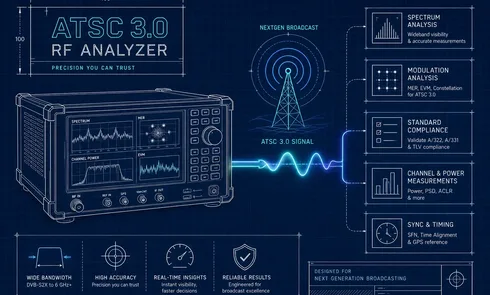
Avateq's monitoring hardware, including the AVQ1020 RF Layer Monitoring Receiver and AVQ1022 RF Signal Analyzer and Monitoring Receiver, is built for exactly this protocol environment. The web-based remote interface gives NOC teams dashboard access without requiring a separate software installation. SNMP and MQTT support are both built in, so the hardware drops into your existing NMS or feeds a modern data pipeline without custom development work. Email alerting and internal logging for offline compliance reporting round out the integration picture.
The AVQ1030 ATSC 3.0 MIMO Receiver and Analyzer extends that capability to cross-polarized dual-channel ATSC 3.0 signals, with two 50-ohm N-type RF inputs, 100 to 1000 MHz tuning range, and dual Gigabit Ethernet ports for network integration. That hardware detail is what matters when you're evaluating whether a system can handle your ATSC 3.0 deployment, not just your legacy ATSC 1.0 infrastructure.
Deployment Architectures for Single-Site and Multi-Site Broadcast Operations
Hub-and-Spoke: The Right Starting Point for Smaller Operations
In a hub-and-spoke deployment, remote sensors report to a single central server or cloud endpoint. It's simple, fast to deploy, and low cost. The trade-off is a single-point dependency at the hub and less resilience at scale. For a single-tower station or a small broadcast group just building out centralized visibility, hub-and-spoke is the natural starting point. There's no reason to over-engineer the architecture before you fully understand your remote RF site management requirements.
Tiered Edge-First Architecture for Multi-Site Networks
Larger operations benefit from local edge processing at each site, with only summarized telemetry and alarms forwarded upstream over WAN. This reduces bandwidth pressure and keeps the site functional even during backhaul outages. The key design decision is whether to forward raw IQ and spectrum data versus processed results and alarms. For most broadcast monitoring use cases, forwarding processed results is the right call: it's bandwidth-efficient and keeps your WAN link from becoming a bottleneck.
Bandwidth Realities Over 4G/5G and WAN Backhaul
Alarm monitoring and periodic telemetry polling work reliably over LTE at very low data rates. Compact RF telemetry, MER/BER trends, and threshold alarms typically fit comfortably in 0.1 to 0.5 Mbps of sustained capacity, the lower end reflecting long polling intervals at a handful of sites, the upper end reflecting shorter intervals or higher site counts with frequent telemetry bursts. Continuous wideband spectrum streaming or IQ capture is a different category entirely and usually requires fixed high-capacity backhaul. Match your architecture to your available link: if you're on 4G cellular with variable signal quality, design for alarm-and-poll rather than continuous stream.
What Leading Solutions Cost and Where They Fit in Your Budget
Entry-Level: Hardware Purchases and Annual Subscriptions for Single Sites
The entry tier spans from roughly $1,300 to $3,000 for hardware-based spectrum monitoring setups. Subscription-based broadcast monitoring options from some European vendors are available at approximately $1,100 USD (roughly €990) per year plus a one-time setup fee, pricing that reflects non-U.S. market positioning and may not include domestic support infrastructure. At this price point you typically get single-location coverage, limited concurrent user access, and basic alarm and telemetry rather than full spectrum analysis. This tier suits a standalone station that needs always-on baseline monitoring without a large capital outlay.
Mid-Tier: Per-Device Licensed Software for Growing Groups
Mid-tier solutions often scale by device count per site. Single-site licenses in this segment run from approximately $21,000 for up to 50 devices to $86,000 for up to 200 devices. The trade-off is real capability and scalability at the cost of software licensing adding to your total cost of ownership. This tier is relevant for broadcast groups managing several transmitter sites under one NOC where you need more than basic alerting and want centralized reporting across locations.
Where Avateq Fits in the Professional-Grade Monitoring Market
Avateq's ATSC 3.0 monitoring hardware is positioned as the value-density choice in this market. The hardware delivers professional-grade analysis with full SNMP and MQTT integration, 24/7 signal monitoring, and multi-standard support including ATSC 1.0 and ATSC 3.0, at a price point that makes it practical to deploy at every transmitter site rather than just flagship locations. That's the differentiation point larger broadcast equipment vendors don't address: they build for main-market stations, not for cost-effective IP-based RF monitoring coverage across an entire transmitter network.
A Practical Checklist to Evaluate and Procure the Right System
Step 1: Define Your Requirements Before Talking to Any Vendor
Run a pre-procurement audit before you open a single sales conversation. Document your site count, the transmitter standards you're operating (ATSC 1.0, ATSC 3.0, or mixed), your existing NMS protocols, your backhaul type and available bandwidth per site, your FCC compliance reporting obligations, and your alarm routing requirements. Getting those specifics on paper streamlines vendor evaluation and prevents scope creep when a vendor tries to upsell capabilities you don't need.
Pay particular attention to mixed-standard environments. A station mid-transition from ATSC 1.0 to ATSC 3.0 needs a monitoring solution that handles both without requiring two separate systems or two separate dashboards. That requirement alone eliminates several vendors before you've spent any time on demos.
Step 2: Shortlist on Protocol Fit, Then Pilot Before You Commit
Use the protocol checklist as your first-pass filter: SNMP version support, MQTT availability, REST API access. Vendors who can't answer those questions clearly, with documentation to back it up, don't make the shortlist. For the survivors, insist on a pilot deployment at one site before committing to a multi-site rollout. Real-world alarm latency, dashboard usability under actual network conditions, and logging reliability are impossible to evaluate from a spec sheet alone.
The Transmitter Site That Doesn't Complain Is the One That Fails Silently
A viewer calling at 2 a.m. is a preventable failure. An FCC documentation gap is a preventable gap. A truck roll triggered because a component was trending toward failure for three days without anyone knowing is a preventable expense. None of that requires the most expensive monitoring system on the market. It requires a system that covers your standards, fits your protocol environment, and is affordable enough to deploy at every site that needs coverage. Deploying the best remote RF monitoring solution for broadcast transmitters solves all three problems at once, and the payback on a single prevented truck roll usually covers the hardware cost for the year.
For ATSC 3.0 operations specifically, Avateq Corp. is a practical starting point. The AVQ1020, AVQ1022, AVQ1030, and AVQ200 product families are built for exactly this use case: always-on, multi-standard RF monitoring with SNMP, MQTT, and web-based remote access at a price point that scales across your entire transmitter network. To see the hardware in your specific deployment context, reach out to the Avateq engineering team to schedule a focused demo conversation, engineering specifics, no sales theater.